

How to Choose Laser Marking Machine for Glass
October 16, 2026
Last updated: 16 October 2026

Na Na
An experienced senior glass machinery sales specialist with extensive knowledge of automated glass cutting equipment and production lines. She writes informative articles on glass processing technologies, machinery selection and manufacturing efficiency.
Laser marking machine for glass technology enables permanent identification marks, including serial numbers, QR codes, logos, and production tracking data, directly onto glass surfaces without contact or consumables. You achieve traceability requirements, anti-counterfeiting functions, and quality management capabilities essential for modern glass manufacturing operations. Industry analysis confirms approximately 39% of new glass processing equipment launched in 2024 featured automation or IoT connectivity, with laser marking systems representing critical components for Industry 4.0 integration.
Shandong Huashil Automation Technology Co., Ltd. manufactures laser marking systems specifically designed for glass processing, including standalone fully automatic models and inline assembly line versions that support thicknesses from 3-19mm with marking speeds reaching 160 m/min. This guide explains laser marking versus laser coding differences, how glass marking technology works, which applications require these systems, and selection considerations for B2B glass fabrication operations.
Laser Marking vs Laser Coding: Understanding the Core Differences
Laser marking creates permanent surface modifications through material property changes, while laser coding typically refers to high-speed printing of variable data for packaging and identification purposes. Both technologies use focused laser beams but differ in depth, permanence, speed requirements, and typical applications.
Laser marking for glass involves surface alteration where the laser beam interacts with glass material causing localized heating that produces visible contrast through micro-cracks, stress marks, or refractive index changes. The marks remain permanently integrated into the glass structure, resisting cleaning chemicals, abrasion, and environmental exposure. You achieve mark depths typically ranging from surface-level (under 0.01mm) to deeper engravings depending on laser power and processing parameters.
Laser coding describes laser-based printing systems optimized for high-speed variable data marking primarily on packaging materials. Coding systems prioritize speed and changeable content (production dates, batch codes, expiration information) over mark depth. While some sources use "laser coding" and "laser marking" interchangeably, glass manufacturing contexts typically distinguish between permanent product marking (laser marking) and temporary packaging information (laser coding).
Technical Process Differences
Laser marking machines for glass use controlled laser power to create permanent identification marks that withstand downstream processing including tempering, lamination, and coating operations. The laser beam energy breaks molecular bonds in localized areas, producing optical contrast visible through reflection or transmission. Marking parameters including laser wavelength, pulse duration, power density, and scanning speed determine final mark quality and permanence.
Laser coding systems emphasize throughput, processing hundreds of products per minute with frequently changing data content. Coding applications focus on outer packaging rather than product surfaces, requiring less mark permanence but greater text updating flexibility. You select marking technology based on whether you need permanent product identification integrated into glass surfaces or temporary batch tracking information on packaging materials.
Application Context for Glass Processing
Glass manufacturers implement laser marking systems for product serialization, quality traceability, regulatory compliance, and anti-counterfeiting requirements. Marks remain readable throughout product lifecycles including residential installation, automotive assembly, or appliance integration. Huashil's automated glass processing solutions incorporate laser marking as essential components within integrated production workflows.
Laser coding finds primary applications in packaging facilities marking cardboard boxes, plastic wrapping, and shipping containers with variable production data. Glass fabrication facilities utilize laser marking for glass surfaces themselves while potentially employing separate coding systems for packaging materials during shipping preparation.
How Laser Marking Machines Work on Glass Surfaces
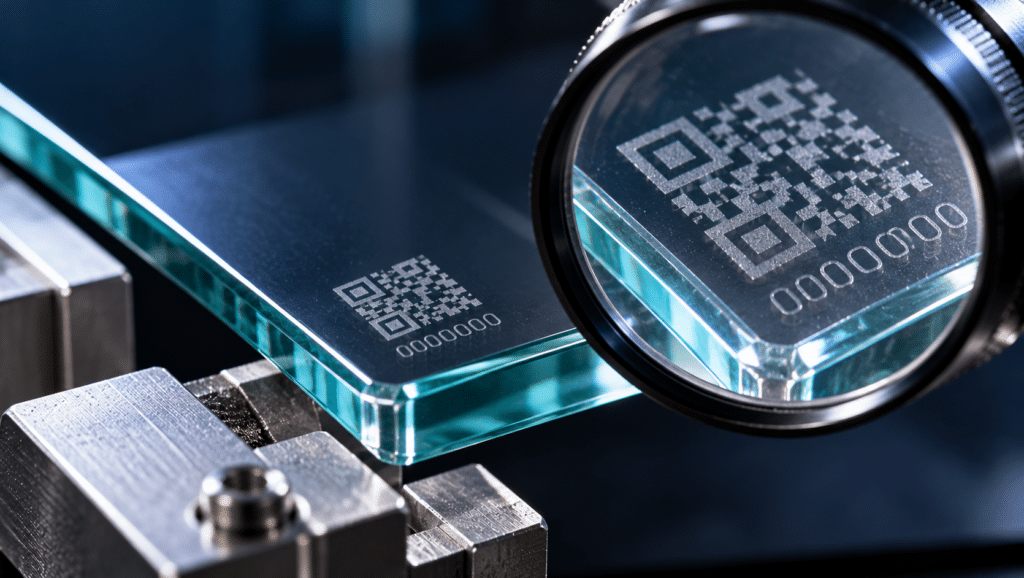
Laser marking machines focus concentrated light energy onto glass surfaces causing localized heating that produces permanent visible marks without removing material or compromising structural integrity. The non-contact process eliminates consumable costs, mechanical wear, and contamination risks associated with traditional marking methods.
The core marking system consists of laser source generating the beam, galvanometer mirrors directing beam position, focusing lens concentrating energy onto the target surface, and control software managing mark patterns and positioning. For glass applications, CO2 lasers (wavelength around 10,600nm) and fiber lasers (wavelength around 1,064nm) represent common technologies, with selection depending on glass type, coating presence, and required mark characteristics.
Huashil's Fully Automatic Laser Marking Machine supports glass thicknesses from 3-19mm with marking speeds up to 160 m/min, integrated process tracking, and anti-counterfeiting functions. The automated system coordinates glass feeding, positioning, marking, and discharge without manual handling between stations.
Marking Process Steps
Glass sheets enter the marking zone through automated conveyors or manual loading depending on system configuration. Position sensors detect glass presence and dimensions, transmitting data to the control system for mark placement calculation. The galvanometer-based scanning system directs laser beam across predetermined paths at speeds reaching thousands of millimeters per second, creating marks through controlled surface heating.
For optimal mark quality on glass, parameters including laser power, scanning speed, pulse frequency, and focal position require precise calibration. Transparent glass typically requires specific laser settings compared to coated glass due to differences in energy absorption characteristics. The marking process completes within seconds for typical identification codes or logos before the next glass sheet advances into position.
Integrated quality verification systems can photograph marked surfaces immediately after processing, comparing actual marks against digital templates to detect positioning errors or insufficient contrast before sheets proceed to downstream operations.
Inline vs Standalone Configurations
Standalone laser marking machines operate as independent stations where operators manually load glass sheets, initiate marking cycles, and remove finished pieces. This configuration suits lower volume operations, prototype development, or facilities with multiple product types requiring flexible marking arrangements. Huashil manufactures standalone models suitable for diverse glass fabrication environments.
Inline laser marking systems integrate directly into automated production lines positioned after cutting operations or before assembly stages. Conveyors deliver glass sheets continuously to marking stations where automated positioning, marking, and verification occur without operator intervention. Huashil's assembly line laser marking solution coordinates with cutting machines, storage systems, and sorting equipment for complete workflow automation.
Inline configuration enables higher throughput, consistent positioning accuracy, and elimination of handling labor between processing stages. You select based on production volume, available floor space, integration requirements with existing equipment, and budget constraints.
Industrial Applications: Who Needs Laser Marking for Glass?
Glass manufacturers requiring product traceability, quality management, anti-counterfeiting protection, or regulatory compliance benefit from laser marking technology. Specific industry applications include automotive glass, architectural curtain walls, appliance components, and consumer electronics displays.
Automotive Glass Manufacturing
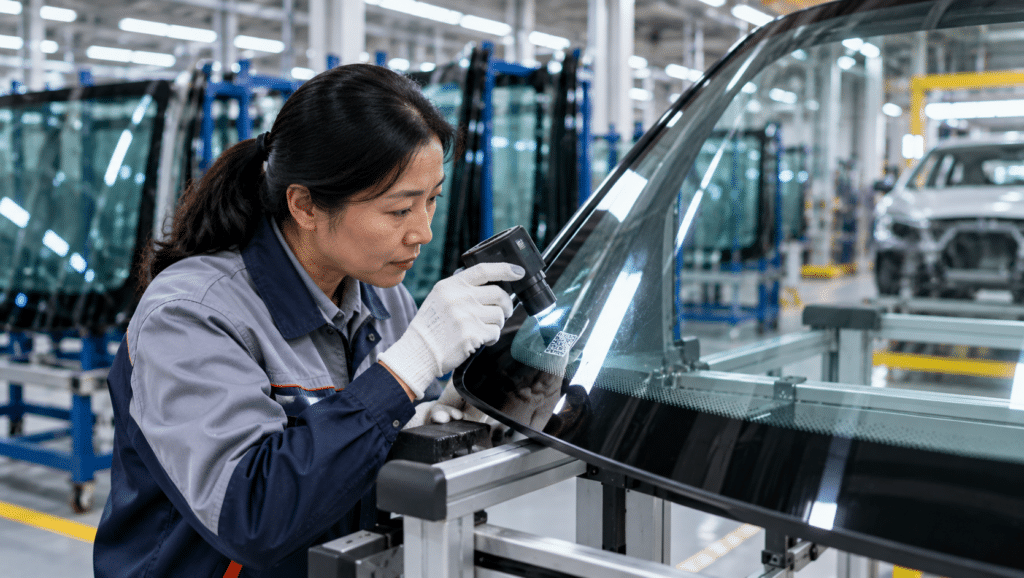
Automotive safety regulations mandate permanent identification marks on windshields and windows including manufacturer codes, certification marks, production dates, and part numbers. Laser marking provides permanent marks that survive tempering processes and remain readable throughout vehicle lifecycles for warranty tracking and safety recall management.
The non-contact marking process eliminates contamination risks on glass surfaces that must meet optical quality standards. Marks typically appear in corners or edge areas where they remain visible after installation but don't obstruct driver visibility. Huashil's laser systems support automotive glass production requirements with appropriate marking speeds for high-volume manufacturing.
Architectural and Curtain Wall Applications
Large-format architectural glass projects require batch tracking, quality documentation, and installation location identification. Laser marking enables permanent codes correlating specific glass panels with manufacturing records including cutting patterns, coating specifications, and quality inspection results.
Project complexity with hundreds of unique panel specifications benefits from automated marking that prevents installation errors. When paired with Huashil's intelligent sorting systems, marked identification codes enable rapid location of specific panels from inventory for sequential installation according to building designs.
Appliance Glass Components
Appliance manufacturers integrate glass components for oven doors, refrigerator shelves, cooktop surfaces, and display panels requiring traceability throughout assembly processes. Laser marking provides permanent identification resistant to cleaning chemicals, temperature cycling, and mechanical handling during appliance production.
Marks enable quality tracking from glass cutting through appliance final assembly, supporting warranty claims investigation and quality improvement initiatives. Huashil serves appliance glass manufacturing with specialized processing solutions including coordinated cutting and marking capabilities.
Consumer Electronics Display Glass
Display glass for smartphones, tablets, and monitors requires precise identification for assembly line coordination and quality management. Laser marking in non-visible edge areas provides serialization enabling product traceability without affecting displayed image areas.
High-volume electronics manufacturing demands marking systems with throughput matching assembly line speeds, consistent positioning accuracy within tight tolerances, and integration with automated material handling equipment. The permanent marks survive display assembly processes including bonding operations and screen testing procedures.
Selection Considerations: Choosing the Right Laser Marking System
Successful laser marking machine selection requires matching laser type, marking speed, integration capabilities, and automation level to your glass processing requirements and production workflow. Understanding these technical factors prevents mismatches between system capabilities and operational needs.
Laser Source Technology
CO2 lasers excel at marking many glass types through thermal surface modification, producing high-contrast marks with relatively deep penetration. The 10.6 micron wavelength absorbs readily in glass material, making CO2 technology suitable for transparent float glass applications. These systems typically cost less than alternative laser technologies for glass marking applications.
Fiber lasers offer advantages for coated glass or applications requiring minimal heat-affected zones. The 1.064 micron wavelength interacts differently with glass surfaces, sometimes requiring specific surface treatments or operating parameters. Fiber lasers demonstrate excellent beam quality, lower maintenance requirements, and potential for higher marking speeds compared to CO2 technology.
UV lasers provide "cold marking" capability minimizing thermal stress in glass through photochemical interactions rather than thermal processes. This technology suits applications requiring extremely fine detail or minimal subsurface damage, though UV laser systems typically cost significantly more than CO2 or fiber alternatives.
Throughput Requirements
Calculate required marking speed by analyzing your daily glass production volume, average mark complexity, and production schedule including shift patterns and potential expansion. Huashil's systems achieve marking speeds up to 160 m/min suitable for high-volume automated production lines.
| Production Volume | Recommended Configuration | Integration Level |
|---|---|---|
| Low (< 500 sheets/day) | Standalone manual loading system | Offline marking station |
| Medium (500-2000 sheets/day) | Semi-automatic with conveyor feed | Partial line integration |
| High (> 2000 sheets/day) | Fully automatic inline system | Complete line integration with ERP |
Overestimating speed requirements wastes capital investment in unnecessary automation, while underestimating capacity forces manual overflow handling or production bottlenecks. Consider peak production periods and future growth when specifying throughput capabilities.
Integration and Automation Features
Evaluate how the marking system will communicate with existing factory automation including cutting machines, quality inspection equipment, and manufacturing execution systems. Modern systems support industrial communication protocols enabling seamless data exchange for coordinated production workflows.
Huashil's laser marking solutions integrate within complete production line configurations, enabling coordinated material flow from storage through cutting, marking, and sorting operations. ERP integration enables automatic work order processing where production orders trigger appropriate marking patterns without manual data entry.
Consider future automation expansion, including additional processing equipment or quality management systems requiring marking system coordination. Select architectures supporting expansion without replacing core control infrastructure.
Mark Quality and Verification
Marking quality requirements depend on application context, including readability distance, scanning method (human visual or automated scanner), mark permanence expectations, and aesthetic considerations. Automotive and regulatory applications often specify minimum mark contrast ratios or character heights.
Integrated vision systems verify mark quality immediately after laser processing, comparing actual marks against digital templates to detect positioning errors, insufficient contrast, or character defects. Automated verification prevents defective marked glass from advancing to downstream operations where rework becomes more costly.
Some applications require no visible marks in final products, with codes placed in areas trimmed during assembly or hidden by frames and mounting hardware. Discuss mark placement requirements with Huashil's technical team during system specification to ensure appropriate marking capabilities.
Why Choose Huashil for Glass Laser Marking Solutions
Huashil delivers specialized glass processing expertise, proven automation integration capabilities, and comprehensive implementation support for laser marking system deployment. Your investment benefits from verified manufacturing experience focused specifically on glass fabrication requirements.
Shandong Huashil Automation Technology Co., Ltd. operates as a National High-tech Enterprise serving over 5,000 domestic customers and exporting to more than 80 countries worldwide. This extensive deployment experience enables Huashil to address glass-specific marking challenges including varied thickness ranges, coating compatibility, and production workflow integration.
Complete Production Line Integration
Huashil's integrated approach coordinates laser marking systems with cutting machines, storage solutions, loading equipment, and intelligent sorting systems into unified production workflows. This turnkey capability eliminates compatibility concerns between separate equipment suppliers while simplifying system commissioning and operator training.
The company's CT-R Smart Factory Integration Solution demonstrates Industry 4.0 capabilities linking cutting, storage, sorting, and marking equipment through centralized production management software. You achieve total workflow visibility, optimized scheduling, and measurable downtime reductions through coordinated automation.
Customization Capabilities
Huashil designs marking systems tailored to your specific glass dimensions, production volumes, and workflow requirements rather than forcing adaptation to standard configurations. Custom integration accommodates existing equipment layouts, building constraints, and operational procedures unique to your facility.
The company's OEM/ODM services enable private labeling for equipment distributors or development of specialized marking solutions for unique glass applications. This flexibility ensures appropriate technical solutions regardless of production scale or product specialization.
Technical Support and Training
Successful laser marking implementation requires proper installation, parameter optimization, operator training, and ongoing maintenance support. Huashil provides installation supervision, ensuring equipment achieves published performance specifications during commissioning.
Comprehensive training covers system operation procedures, laser safety protocols, routine maintenance tasks, troubleshooting common issues, and software functionality for mark pattern creation. Thorough training reduces startup learning curves and helps production staff achieve full system utilization quickly.
Ongoing support continues after installation through remote diagnostic capabilities and direct communication with factory engineering staff. ISO 9001 certification and CE marking demonstrate commitment to quality management and product safety standards.
Conclusion
Laser marking machine for glass technology enables permanent product identification, quality traceability, anti-counterfeiting protection, and regulatory compliance through non-contact surface modification that survives downstream processing and product lifecycles. You achieve measurable benefits including eliminated consumable costs, reduced handling labor, improved quality management, and seamless integration within automated production workflows. Understanding differences between laser marking for permanent product identification and laser coding for temporary packaging information guides appropriate technology selection for your glass processing applications.
Huashil provides specialized glass laser marking expertise through standalone and inline configurations supporting glass thicknesses from 3-19mm with marking speeds reaching 160 m/min, integrated process tracking, and comprehensive factory automation integration. The company's complete production line approach, customization capabilities, proven deployment experience across 80+ countries, and sustained technical support position your glass fabrication operation for competitive advantages in production efficiency and quality management. Evaluate your marking requirements and contact Huashil to discuss how laser marking technology optimizes your glass manufacturing operations.
Frequently Asked Questions
What types of glass can laser marking machines mark?
Laser marking machines mark float glass, tempered glass, laminated glass, coated glass including Low-E surfaces, tinted glass, and patterned glass surfaces. Huashil's systems support glass thicknesses from 3-19mm with adjustable parameters accommodating different glass types and surface characteristics. Mark quality and contrast vary by glass composition, coating presence, and surface treatments requiring parameter optimization during commissioning. Verify your specific glass products during equipment evaluation to ensure appropriate marking capabilities for all materials you process.
How fast can automated laser marking systems process glass?
Automated laser marking systems process glass at speeds up to 160 m/min depending on mark complexity, glass size, and required positioning accuracy. Huashil's inline assembly line configurations coordinate marking speed with upstream cutting operations and downstream sorting equipment for continuous material flow. Simple alphanumeric codes mark faster than complex logos or detailed graphics due to reduced laser path length. Discuss your typical mark patterns and required throughput with Huashil engineering to specify appropriate system speed capabilities matching your production requirements.
Can laser marking survive tempering and lamination processes?
Yes, properly applied laser marks survive downstream tempering, lamination, and coating processes when positioned appropriately and applied with suitable parameters. The permanent surface modifications remain readable after heat treatment cycles exceeding 600°C during tempering operations. Position marks in areas not subjected to aggressive processing or in locations where mark visibility requirements allow some character degradation. Huashil's marking systems accommodate automotive and architectural applications requiring mark permanence through complete manufacturing workflows including all secondary processing stages.
Do laser marking machines require consumables or special maintenance?
Laser marking machines require no consumables during normal operation, eliminating ongoing costs for inks, solvents, or marking materials associated with alternative identification technologies. Routine maintenance includes lens cleaning, mirror alignment verification, filter replacement, and annual laser source calibration depending on operating hours and environmental conditions. Huashil provides detailed maintenance schedules and training covering routine tasks preventing unplanned downtime4. Major component replacement intervals typically exceed multiple years of operation based on duty cycle and proper maintenance procedures.
How do laser marking systems integrate with existing production lines?
Laser marking systems integrate with existing production lines through industrial communication protocols including OPC-UA, Ethernet/IP, and Modbus connections, enabling bidirectional data exchange with line control systems. Huashil's solutions coordinate with cutting machines, conveyors, and quality inspection equipment through centralized production management software. Physical integration requires appropriate conveyor interfaces, position sensors, and glass handling mechanisms compatible with your current equipment layout. Discuss your facility configuration and existing automation infrastructure with Huashil engineering to develop an appropriate integration approach minimizing production disruption during installation.
References
1: Huashil Technology, "What Is Huashil? Complete Guide to Shandong Huashil Technology 2025," 2025. Approximately 39% of new glass processing equipment launched in 2024 featured automation or IoT connectivity (360 Research Reports, 2025). Huashil's CT-R Smart Factory Integration Solution links cutting, storage, sorting, and production management into unified workflows for Industry 4.0 integration. https://huashil-china.com/what-is-huashil-complete-guide-shandong-huashil-technology-2025/
2: REA JET, "Laser Marking," 2024. Laser marking includes various laser marking, laser coding and laser engraving processes for applications on glass including window glass, drinking glasses, and mirrors. Technical distinction exists between permanent product marking and temporary packaging coding applications. https://www.rea-jet.com/en/service/scope-service/glossar/laser-marking
3: Huashil Technology, "Fully Automatic Laser Marking Machine For Glass," 2025. The machine supports glass thicknesses from 3-19mm and marking speeds up to 160 m/min. Integrated process tracking and anti-counterfeiting functions help ensure product authenticity with high-precision coding and traceable identification marks. https://huashil-china.com/product/fully-automatic-laser-marking-machine
4: Huashil Technology, "Fully Automatic Laser Marking Machine," 2025. System maintains ISO9001 quality management system certification and CE certification. Provides automated marking with high recognition rate supporting real-time workflow tracking, progress reporting, and management updates compatible with supplementary data input and remote tracking. https://huashil-china.com/fully-automatic-laser-marking-machine


" Talk to Na Na About This Machine "
Transform your glasswork with clear, clever, and efficient tech that
makes every process smooth. Connect with us and upgrade now!

Reliable, high-quality glass processing systems. Together, we’ll transform your vision into reality.
Company Info
Products Category
Contact
Copyright © 2026 huashil-china.com