

How to Choose an Intelligent Glass Arrangement System for Your Factory
September 25, 2026
Last updated: 25 September 2026

Na Na
An experienced senior glass machinery sales specialist with extensive knowledge of automated glass cutting equipment and production lines. She writes informative articles on glass processing technologies, machinery selection and manufacturing efficiency.

Intelligent glass arrangement system technology transforms glass handling operations through automated sorting, precise positioning, and real-time process monitoring that eliminates manual matching and labeling tasks. You achieve significant production efficiency improvements when scattered glass inputs automatically detect frame specifications, optimize positioning based on work order requirements, and coordinate seamlessly with downstream processing equipment. Modern glass sorting machine systems support ERP data integration, work order scanning, and intelligent matching algorithms that replace labor-intensive manual operations while maintaining consistent accuracy. Industry research confirms buffer and sorting systems enable smooth continuous supply to processing stages through intermediate storage and optimized retrieval based on production progress1.
Shandong Huashil Automation Technology Co., Ltd. specializes in intelligent glass processing automation including glass arrangement systems with real-time parameter monitoring and high-accuracy positioning control. This guide explains what intelligent glass arrangement systems are, how automated glass arrangement technology works within production workflows, who benefits from implementation, and critical selection considerations for B2B glass fabrication operations.
What Is an Intelligent Glass Arrangement System and How Does It Function?
An intelligent glass arrangement system automates glass sheet sorting, positioning, and matching operations through computer-controlled conveyors integrated with production management software. These systems coordinate glass movement between processing stages using sensors, positioning mechanisms, and intelligent matching algorithms based on work order specifications.
The system architecture includes input conveyors that receive scattered glass sheets from cutting operations, detection sensors that identify glass dimensions and characteristics, positioning mechanisms that arrange sheets according to production requirements, and control software that compares specifications against ERP data and work orders. Huashil's Intelligent Glass Sheet Sorting System monitors movement parameters in real time, controls precise positioning with high accuracy, and inputs scattered glass while detecting frame mode rules for automated matching2.
Core System Components
The input section receives glass sheets from upstream cutting or processing equipment using powered roller conveyors or belt systems. Photoelectric sensors detect glass presence and measure dimensions, transmitting data to the control system for comparison with production orders. The positioning system uses servo-controlled stops, pneumatic pushers, or robotic arms to orient glass sheets according to specified arrangements.
Detection accuracy determines system effectiveness in identifying glass specifications including thickness, coating presence, and dimensional tolerances. High-precision sensors verify glass characteristics match production requirements before advancing sheets to subsequent processing stages, preventing quality issues from specification mismatches.
The control architecture coordinates multiple system functions including sensor data processing, position calculation, timing sequencing with adjacent equipment, and production tracking through ERP integration. This centralized coordination ensures reliable operation even when processing complex work orders with multiple glass specifications.
Automated Matching and Positioning Process
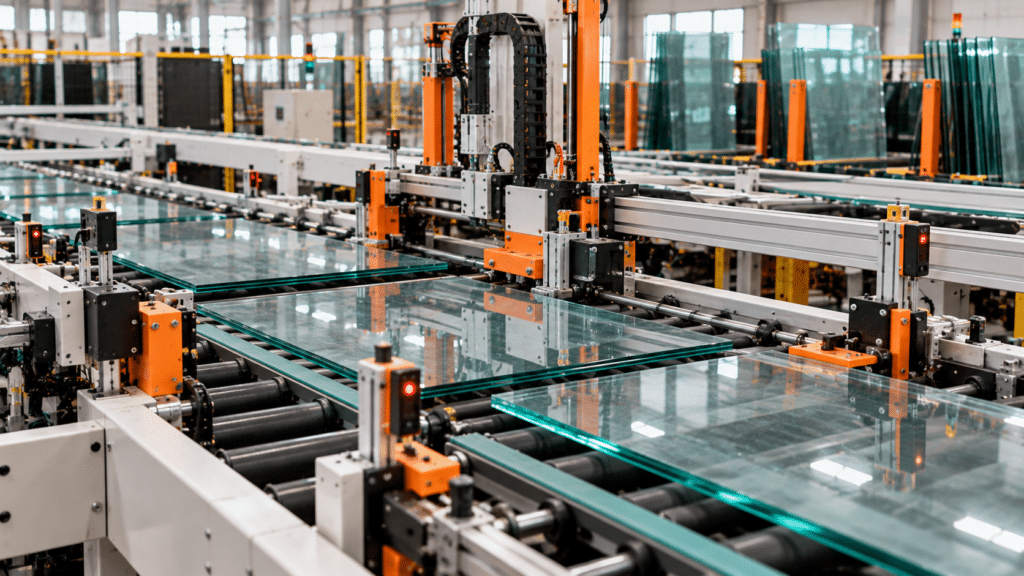
When glass sheets enter the arrangement system, sensors capture dimensional and specification data that the control software compares against active work orders. The intelligent matching algorithm identifies appropriate pairings for multi-layer products like insulating glass units, where upper and lower panes must match precisely.
For single-frame arrangements, the system organizes different glass types according to work order sequences, enabling efficient processing of diverse specifications without manual sorting. Huashil's system enables automatic matching and pairing of two different glass frames based on work order requirements, particularly suitable for online production integration in China2.
Positioning accuracy directly impacts downstream processing efficiency and product quality. Precise glass placement ensures proper alignment during assembly operations, reduces handling corrections, and maintains consistent spacing in automated production lines. Systems typically achieve positioning accuracy within ±1mm to support tight manufacturing tolerances.
ERP Integration and Work Order Coordination
Modern glass positioning system technology integrates directly with enterprise resource planning software to receive work order specifications and transmit production status updates. This bidirectional communication enables real-time production tracking and automatic schedule adjustments based on material availability and processing capacity.
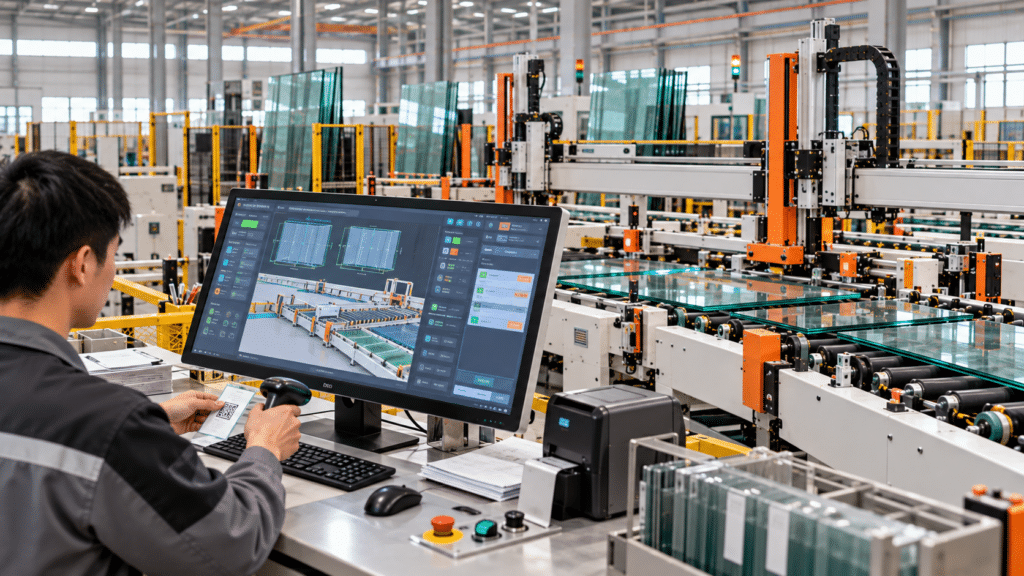
Work order scanning functionality allows operators to initiate production runs by scanning barcodes or QR codes associated with specific orders. The system automatically retrieves order specifications, configures sorting parameters, and begins processing without manual data entry. Huashil's system supports ERP data comparison and work order scanning for streamlined production coordination2.
Integration eliminates paperwork between planning and production, reduces order entry errors, and provides management visibility into real-time factory status. Production managers access current order progress, material consumption, and equipment utilization through integrated dashboards that consolidate data from multiple factory systems.
Key Benefits: How Glass Sorting Machine Automation Improves Operations
Glass sorting machine implementation delivers measurable improvements in labor efficiency, positioning accuracy, production throughput, and quality consistency. Understanding specific operational benefits helps you evaluate whether arrangement system automation justifies capital investment for your glass fabrication operation.
Eliminated Manual Matching and Labeling
Traditional glass handling requires operators to visually inspect sheets, manually match specifications for multi-layer products, apply identification labels, and organize sheets for subsequent processing. These manual operations consume significant labor hours while introducing opportunities for specification errors and physical handling damage.
Automated glass arrangement replaces manual matching, labeling, and tearing processes, significantly improving production efficiency2. You eliminate the labor costs associated with specification verification, reduce errors from mismatched glass pairings, and accelerate material flow between processing stages. Research confirms automated systems virtually eliminate human errors in picking and inventory management, resulting in higher order accuracy and fewer discrepancies3.
For insulating glass production involving two or more glass layers with specific coating orientations, automated matching ensures proper pairing without relying on operator judgment. The system tracks coating positions, glass thicknesses, and dimensional specifications automatically, preventing costly assembly errors.
Improved Production Throughput
Manual glass sorting and arrangement creates bottlenecks that limit overall production line speed. Operators require time to verify specifications, locate matching sheets, and physically position glass for downstream equipment. These delays accumulate throughout production shifts, reducing daily output and extending delivery times.
Automated systems process glass sheets continuously at consistent speeds determined by conveyor velocity and positioning cycle times. The system operates during breaks and shift changes without productivity variations, enabling higher daily throughput from existing factory floor space. Industry analysis confirms buffer and sorting systems enable smooth continuous supply of process steps through intermediate storage and optimized retrieval1.
Throughput improvements prove particularly valuable during high-volume production periods when manual operations struggle to maintain consistent speeds. Automated systems handle peak demand without overtime costs or temporary labor additions.
Enhanced Quality Control
Automated specification verification prevents glass with incorrect characteristics from entering production batches. The system cross-references detected specifications against work order requirements, automatically rejecting mismatched sheets before they cause quality issues in finished products.
Positioning accuracy ensures consistent glass alignment during assembly operations, reducing variations that cause sealant gaps, optical distortions, or dimensional non-conformances. Precise placement eliminates manual adjustment steps that consume time and introduce handling risks.
Real-time monitoring tracks system performance parameters including positioning accuracy, cycle times, and reject rates. Operators receive alerts when parameters drift from acceptable ranges, enabling corrective action before quality issues emerge in finished products. This proactive quality management reduces scrap costs and prevents delivery of non-conforming products to customers.
Flexible Production Scheduling
Intelligent glass arrangement systems adapt quickly to changing work order sequences without physical reconfiguration or extensive operator retraining. Schedule changes update automatically through ERP integration, with the system immediately processing new specifications without manual setup adjustments.
This scheduling flexibility enables you to accommodate rush orders, priority customers, or unexpected production interruptions without disrupting overall factory efficiency. The system seamlessly transitions between diverse glass specifications, supporting make-to-order business models that differentiate your operation from competitors constrained by rigid production sequences.
Multi-specification processing capability within single production runs maximizes equipment utilization and reduces changeover downtime. You process smaller order quantities economically while maintaining competitive delivery times for varied customer requirements.
Industrial Applications: Who Benefits from Automated Glass Arrangement?
Automated glass arrangement technology delivers operational value for glass processors handling multiple specifications requiring organized material flow between processing stages. Specific industry applications benefit based on product complexity and production volume characteristics.
Insulating Glass Manufacturing
Insulating glass unit fabrication requires precise matching of glass pairs including dimensional alignment, coating orientation compatibility, and thickness coordination. Manual matching operations prove time-consuming and error-prone when processing diverse specifications across multiple orders simultaneously.
Intelligent glass arrangement systems excel at automated pairing verification that ensures upper and lower glass sheets meet specification requirements before entering sealing operations. The system tracks coating positions (Low-E coatings typically face specific cavity positions), verifies dimensional compatibility within tolerance limits, and sequences matched pairs according to production schedules.
Automated arrangement particularly benefits operations producing architectural insulating glass with large sheet sizes, where manual handling risks damage and positioning accuracy directly impacts sealing quality. The system coordinates glass flow from cutting through assembly while maintaining traceability of component specifications throughout the process.
Architectural Curtain Wall Production
Architectural glass fabricators process dozens of distinct specifications within single building projects, including varied sizes, thicknesses, coatings, and tint levels. Manual sorting and arrangement of this product variety consumes significant labor while risking specification errors that cause costly field corrections.
Automated systems organize diverse specifications according to installation sequences, enabling efficient production of complete project packages without manual sorting between processing stages. Work order integration ensures glass sheets advance through cutting, edging, assembly, and quality inspection in sequences matching field installation requirements.
The arrangement system supports project-based manufacturing by maintaining specification integrity throughout complex production workflows. You deliver complete building packages with confidence that all glass specifications match architectural drawings and installation schedules.
Automotive Glass Processing
Automotive glass production involves repetitive manufacturing of standardized windshield and window specifications with tight quality tolerances. Automated arrangement enables consistent material flow between cutting, tempering, and assembly operations without manual handling delays.
The system sequences glass sheets according to vehicle model requirements, automatically grouping specifications for batch processing through tempering operations. Consistent positioning maintains proper alignment during curvature forming, ensuring dimensional compliance with vehicle mounting specifications.
High-volume automotive production justifies arrangement automation investment through labor savings and throughput improvements. The system operates continuously across multiple shifts, maintaining consistent production rates that support just-in-time delivery requirements from automotive assembly plants.
Multi-Product Glass Fabrication
Glass processors serving diverse markets including furniture, appliances, and commercial interiors handle wide product variety with frequent specification changes between orders. Manual arrangement of this product mix requires constant operator attention to prevent specification errors and processing delays.
Automated systems accommodate product variety through flexible work order processing that adjusts sorting and positioning parameters based on current production requirements. The system transitions seamlessly between different glass types, thicknesses, and sizes without physical reconfiguration or extended changeover periods.
Arrangement automation enables competitive processing of smaller order quantities by reducing manual handling labor and improving changeover efficiency. You serve diverse customer requirements profitably while maintaining short lead times across varied product specifications.
Selection Considerations: Choosing the Right Glass Positioning System
Successful intelligent glass arrangement system selection requires matching processing capacity, positioning accuracy, integration capabilities, and physical footprint to your production requirements and facility constraints. Understanding these technical factors prevents costly mismatches between system capabilities and operational needs.
Processing Capacity Requirements
Calculate required throughput by analyzing your daily glass volume, average sheet dimensions, and peak production periods. Include buffer capacity for order fluctuations and future production growth when specifying system capacity.
| Consideration | Calculation Method | System Requirements |
|---|---|---|
| Daily Volume | Total sheets processed per shift × number of shifts | Conveyor speed and cycle time capacity |
| Sheet Size Range | Minimum and maximum glass dimensions you process | Conveyor width and positioning range |
| Specification Variety | Number of distinct glass types in typical production week | Sensor detection capabilities and software flexibility |
| Integration Timing | Upstream and downstream equipment cycle times | Coordination speed and buffer capacity |
Overestimating capacity wastes capital investment and factory floor space, while underestimating capacity forces continued manual handling for volume exceeding automated system limits. Work with Huashil's technical team to specify appropriate capacity based on actual production data and growth projections.
Positioning Accuracy and Detection Capabilities
Positioning accuracy determines how precisely the system places glass sheets relative to target locations. Tighter accuracy proves critical for applications requiring precise alignment during downstream assembly operations or automated handling equipment with narrow clearances.
Detection capabilities define which glass characteristics the system can identify including thickness measurement, coating presence, surface quality defects, and dimensional tolerances. More sophisticated detection enables better specification verification and quality control integration.
Verify positioning accuracy specifications match your tightest assembly tolerance requirements. Consider future automation plans that may demand tighter positioning than current manual processes require.
ERP and Factory Automation Integration
Evaluate how the arrangement system will communicate with existing factory automation including cutting machines, assembly equipment, and enterprise resource planning software. Modern systems support standard industrial communication protocols enabling seamless data exchange.
Work order integration eliminates manual production scheduling and enables real-time status visibility for production management. Specification data flows automatically from order entry through arrangement, processing, and quality verification without operator transcription.
Consider future automation expansion including additional processing equipment or quality inspection systems that may require arrangement system coordination. Select architectures that support expansion without replacing core control systems.
Physical Installation Requirements
Measure available factory floor space, conveyor heights, and material flow pathways to determine feasible system configurations. Arrangement systems require adequate clearances for glass entry, exit, and reject handling without interfering with existing equipment.
Identify glass delivery points from upstream cutting equipment and pickup locations where downstream processing begins. Arrange conveyor paths to minimize glass travel distance while maintaining safe operator access for system maintenance and material handling.
Verify building electrical capacity accommodates arrangement system power requirements for conveyor drives, pneumatic systems, and control equipment. Plan electrical upgrades during installation if necessary.
Why Choose Huashil for Intelligent Glass Arrangement System Implementation
Huashil delivers proven glass processing automation expertise, customizable arrangement solutions, and comprehensive implementation support for glass fabrication operations. Your investment benefits from verified manufacturing capabilities that ensure reliable long-term system performance.
Shandong Huashil Automation Technology Co., Ltd. specializes in intelligent glass processing systems including sorting, arrangement, cutting, and storage solutions that integrate seamlessly into coordinated production workflows. This comprehensive automation expertise enables Huashil to design arrangement systems that coordinate effectively with your existing equipment while supporting future expansion plans.
Customization Capabilities
Huashil designs arrangement systems tailored to your specific glass sizes, production volumes, and workflow requirements rather than forcing adaptation to standard configurations. Custom conveyor dimensions accommodate your maximum glass sheet sizes, while modular architecture enables capacity expansion as production grows.
The company's integrated approach combines arrangement systems with cutting machines, loading equipment, and storage solutions into coordinated production lines. This turnkey capability simplifies supplier management and ensures component compatibility across the automation system.
Real-Time Monitoring and Control
Huashil's intelligent glass arrangement system monitors movement parameters in real time, providing operators immediate feedback on system performance and production status. High-accuracy positioning control maintains consistent glass placement across extended production runs without manual calibration adjustments.
The control interface displays current production order information, glass specifications being processed, positioning accuracy metrics, and system operating status. Operators access this information through intuitive touchscreen interfaces that require minimal training for effective operation.
Technical Support and Training
Successful arrangement system implementation requires proper installation, operator training, and ongoing technical support. Huashil provides installation supervision ensuring equipment assembly achieves published performance specifications during commissioning.
Comprehensive training covers system operation procedures, routine maintenance tasks, troubleshooting common issues, and software functionality for work order processing. Thorough training reduces startup learning curves and helps production staff achieve full system utilization quickly.
Ongoing technical support continues after installation through remote diagnostic capabilities and direct communication with factory engineering staff. This sustained support helps you maintain production continuity and resolve technical issues before they impact delivery commitments.
Conclusion
Intelligent glass arrangement system technology delivers measurable operational improvements through automated glass sorting, precise positioning, and real-time process monitoring that replaces labor-intensive manual matching and labeling tasks. You achieve significant benefits including eliminated specification errors, improved production throughput, enhanced quality control, and flexible scheduling that accommodates diverse work order requirements. Successful implementation requires careful evaluation of processing capacity needs, positioning accuracy requirements, ERP integration capabilities, and physical installation constraints to match system specifications with your production workflow.
Huashil provides proven glass processing automation expertise, customizable arrangement solutions, comprehensive implementation support, and sustained technical assistance for glass fabrication operations. The company's specialized focus on intelligent glass systems, integrated production line design capabilities, and customer-focused customization position your operation for competitive advantages in production efficiency and quality consistency. Evaluate your glass handling requirements and contact Huashil to discuss how intelligent glass arrangement system technology can optimize your fabrication operations.
Frequently Asked Questions
What glass specifications can intelligent arrangement systems detect?
Intelligent glass arrangement systems detect glass dimensions (length and width), thickness, coating presence, and surface characteristics using optical and proximity sensors. Huashil's system inputs scattered glass while accurately detecting frame specifications and optimizing positioning based on work order comparison rules. Detection capabilities vary by system configuration, with more advanced sensor packages identifying additional characteristics including coating type, glass tint, and surface defects. Verify your required detection specifications during system evaluation to ensure compatibility with all glass products you process.
How do glass sorting machines integrate with ERP software?
Glass sorting machines integrate with ERP software through standard industrial communication protocols including OPC-UA, Ethernet/IP, or Modbus TCP connections. Huashil's intelligent glass sheet sorting system supports ERP data comparison and work order scanning functionality that enables automated production coordination. Integration enables bidirectional communication where the arrangement system receives work order specifications from ERP and transmits production status, material consumption, and completion data back to the ERP system. Discuss your current ERP platform with Huashil engineering staff to verify integration compatibility and identify required interface components.
Can automated glass arrangement handle multiple glass types simultaneously?
Yes, automated glass arrangement systems process multiple glass types simultaneously by identifying specifications through sensor detection and sorting according to work order requirements. Huashil's system arranges different glass types within single frames and dispatches them sequentially per work order specifications, ideal for offline production applications. The system maintains specification integrity by tracking each glass sheet's characteristics throughout the arrangement process, preventing mixing of incompatible specifications. Processing capacity for simultaneous types depends on system configuration, conveyor layout, and production workflow requirements.
What maintenance do intelligent glass positioning systems require?
Daily maintenance includes visual inspection of conveyor operation, sensor cleaning, and pneumatic system pressure verification. Weekly tasks involve guide rail cleaning, positioning mechanism alignment checks, and control system diagnostic reviews. Monthly maintenance schedules include sensor calibration verification, conveyor belt tension adjustment, pneumatic actuator lubrication, and mechanical component inspection. Huashil provides detailed maintenance schedules and comprehensive training covering routine tasks that prevent unplanned downtime. Annual maintenance may require professional service for major component inspection and software updates depending on system utilization levels.
How long does intelligent glass arrangement system installation take?
Installation duration depends on system size, conveyor complexity, and integration requirements with existing equipment. Basic standalone arrangement systems typically require 1-2 weeks for mechanical installation, electrical connection, and software commissioning. Integrated systems coordinating with cutting lines, assembly equipment, and ERP software may require 3-4 weeks including interface development, production workflow testing, and operator training. Facility preparation including floor modifications or electrical upgrades extends total project duration. Huashil provides detailed implementation schedules during project planning including preparation requirements, installation phases, testing periods, and training timelines.
References
1: LISEC, "The wave of automation in the flat glass industry," 2024. Buffer and sorting systems enable smooth continuous supply to process steps through intermediate storage of semi-finished products that can be retrieved in line with production progress. Software solutions control and optimize material flow through machine networks, tracking each pane's origin, completed production steps, and final location. https://blog.lisec.com/automation_flat_glass_industry
2: Huashil China, "Intelligent Glass Sheet Sorting System," 2025. Monitors parameters in real time and controls precise positioning with high accuracy. Inputs scattered glass while detecting and optimizing based on frame mode rules for automated matching, replacing manual matching, labeling, and tearing processes. Supports ERP data comparison and work order scanning. Enables automatic matching and pairing of two different glass frames based on work order requirements. Arranges different glass types within single frames and dispatches sequentially per work order. https://huashil-china.com/product/intelligent-glass-sheet-sorting-system/
3: ASC Software, "Automated Storage and Retrieval Systems: A Complete Guide," 2024. Automated systems minimize human error in inventory management and order fulfillment, achieving near-perfect accuracy rates. Space utilization optimized as automated systems operate in tighter spaces and make better use of vertical storage. Systems can operate 24/7, increasing productivity. https://ascsoftware.com/blog/automated-storage-and-retrieval-system-guide


" Talk to Na Na About This Machine "
Transform your glasswork with clear, clever, and efficient tech that
makes every process smooth. Connect with us and upgrade now!

Reliable, high-quality glass processing systems. Together, we’ll transform your vision into reality.
Company Info
Products Category
Contact
Copyright © 2026 huashil-china.com